If you’ve ever stood in an elevator, feeling that smooth, almost effortless glide between floors, you probably never stopped to think about the small, critical parts making that happen. As an elevator wheel supplier, I get questions all the time: “Why don’t these wheels slip off the cables? What’s with that rounded shape everyone calls a ‘crowned’ wheel anyway?” It’s not just a random design—this little detail is the reason elevators don’t get stuck mid-floor, and why rides stay consistent even after thousands of trips. Let’s break down how a crowned elevator wheel works, straight from someone who builds them day in and day out. Elevator Wheel
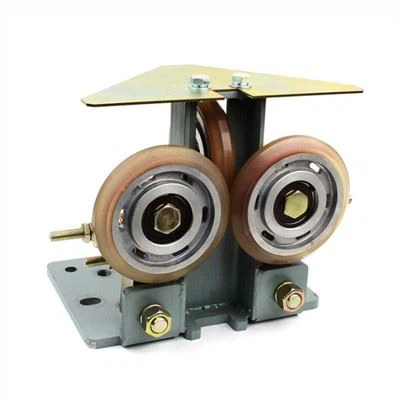
First, let’s start with basics. Elevator systems rely on steel cables (we call them “ropes” in the industry, even though they’re more like thick, braided wire) that wrap around multiple wheels. Some wheels are drive wheels—they hook to a motor to pull the ropes up and down. Others are idler wheels, just there to guide the ropes so they don’t tangle or rub against other parts. Crowned wheels are the go-to for both, but their real superpower is stopping those ropes from slipping off the edge.
Wait, what even is a crowned wheel? It’s not flat like a car tire. It’s shaped like a very gentle hill—rounded at the center, curving slightly downward toward the edges. The peak of the hill is right in the middle of the wheel’s face. If you were to draw a cross-section of it, it’s almost like a tiny, soft arc, not a sharp point or a steep curve. Now, why does that shape matter so much? Let’s think about what happens if a wheel is flat. If the rope shifts even a little to one side, there’s nothing to push it back. It could ride right off the edge, jam into the side of the elevator shaft, and bring the whole system to a halt. That’s a nightmare for everyone—passengers stuck between floors, maintenance teams scrambling, and us getting frantic calls to fix a preventable issue. The crown eliminates that risk, but it’s not magic—it’s physics.
Here’s the key: when a rope sits on a crowned wheel, it naturally centers itself. Let’s say the rope is pulled a tiny bit toward the left edge of the wheel. The rounded shape on the right side of the wheel (relative to the rope’s position) is a little higher than where the rope is sitting. So there’s more contact area between the rope and the wheel on the right side than the left. Friction increases with more surface contact, right? So the right side grips harder than the left, pulling the rope back toward the center. Same thing if it shifts right—left side has more grip, pushes it back. It’s a self-centering system that works no matter how the wheel turns, how heavy the load is, or how worn the rope gets over time. We test this all the time in our warehouse: we load test wheels with ropes pulled at angles that would make a flat wheel slip, and the crowned ones always track straight.
But wait, it’s not just the shape. There are a few other factors we build into these wheels to make them work right, because a bad crown is worse than no crown at all. First, the height of the crown is super specific. If it’s too steep, the rope will bounce around instead of staying centered, especially when the elevator starts or stops suddenly (that jolt you feel when you hit a floor? We design around that). If it’s too shallow, it won’t have enough grip to pull the rope back. For standard residential elevators, we use a crown height of about 0.5% of the wheel’s total width. So a 24-inch wide wheel has a crown peak that’s 0.12 inches higher than the edges. That tiny difference is all it takes. For commercial elevators, which carry way heavier loads, we adjust the crown a little—maybe 0.6%—to handle the extra tension on the ropes without throwing off the balance.
Another thing: the material. Crowned elevator wheels aren’t made of plastic, obviously. We use cast iron for most residential systems, and ductile iron for commercial and industrial setups because it’s stronger and more resistant to wear. Some high-speed elevators use steel, but that’s for when the rope speeds are over 1,000 feet per minute. The material has to be rigid, too—if the wheel bends even a little under load, the crown flattens out, and you’re back to the slipping problem. That’s why we machine each wheel after casting to get the exact crown shape; no casting is perfect, so precision machining is non-negotiable for us.
And let’s talk about ropes, because the wheel and the rope have to work together. Elevator ropes are made of multiple strands of steel, twisted into a helix. That twist means when the rope wraps around a wheel, it pulls a little to the side naturally. On a flat wheel, that twist makes the rope crawl toward one edge of the wheel over time—this is called “rope creep.” It’s not a quick issue, but after months or years, the rope will shift so far it comes off. The crown stops that creep too, because it pulls the rope back toward the center before it can drift too far. We see this all the time with replacement parts: a lot of our customers come to us with old flat wheels that are worn where the rope used to ride, and they’re surprised how much smoother the system runs when they switch to crowned wheels.
Wait, does the size of the wheel matter? Yep. For small home elevators, the wheels are usually 16 to 24 inches in diameter. For high-rise buildings, they can be up to 5 feet across. The crown adjusts with the size, too—bigger wheels have a slightly smaller crown percentage, because the diameter already gives the rope more surface area to sit on. If we put the same 0.5% crown on a 5-foot wheel, the peak would be way too high, and the rope would hop instead of tracking. It’s all proportional.
Now, let’s address a common misconception: some people think the crown is just a trick to make the wheel look fancy, but no—it’s a safety feature. Elevator systems are regulated in almost every country, and crowned wheels are standard code for a reason. Back in the day, before crowned wheels were common, elevators had a lot more derailments. Maintenance crews had to lubricate the wheels constantly to keep ropes from slipping, which created other problems—grease getting on the ropes, making them weaker, or grease dripping onto the elevator cabin floor. The crowned wheel cuts down on maintenance too, because it doesn’t need as much lubrication to stay centered. That’s a win for building owners, who hate unexpected service calls, and for us, because it means fewer replacement parts down the line.
From a supplier’s perspective, we’ve learned a lot over the years about what works and what doesn’t. A few years back, we tried a “custom” crown for a high-rise client—we made it a little steeper than standard to reduce wheel size. Big mistake. The ropes started bouncing during fast descents, and after a month, two ropes slipped off during a test run. We had to replace the entire set of wheels, and that taught us a lesson: the crown isn’t something to mess with unless you know exactly how the system is set up. Now, we design every wheel based on the client’s specific elevator speed, load, and rope size. No one-size-fits-all here, even though the basic crown shape is the same for most applications.
Another thing: wear and tear. Even the best crowned wheels wear out, and the crown is the first part to go. The area where the rope rides is called the “tread,” and over time, the steel from the rope abrades it, and the crown gets worn down to flat. When that happens, you’ll notice the elevator starting to make a weird squeal, or the cabin drifting slightly when it stops. That’s the crown gone. So when you’re replacing elevator wheels, don’t just swap in any wheel—make sure it has the correct crown. A lot of cheap generic wheels cut corners and don’t machine the crown properly, so they’ll fail faster. As a supplier, we prioritize precision over cost because we know how critical these parts are.
Let’s walk through a quick example to make it real. Say you have a 10-story commercial building with an elevator that carries 3,000 pounds, moving at 500 feet per minute. The drive wheel here is 36 inches in diameter, made of ductile iron. We machine a crown that’s 0.6% of 36 inches, so about 0.216 inches from edge to peak. When the elevator starts moving, the motor turns the drive wheel, and the ropes wrap around it. If one rope shifts just 1/8 of an inch left, the right side of the wheel’s tread is higher, so there’s 20% more contact area between the rope and the wheel on the right. That extra friction pulls the rope right back to the center, no extra parts needed, no complicated sensors, just simple physics. And because the crown is gentle, the rope doesn’t get damaged from being pushed back and forth.
Now, if you were to replace that 36-inch crowned wheel with a flat one, here’s what happens. The ropes might shift to one side, rub against the elevator shaft wall, and fray. The elevator would make a grinding noise every time it passes the drive wheel, and eventually, the ropes would wear out much faster, needing replacement in half the time. That’s why building managers always ask for crowned wheels when they order replacements, even if they don’t know exactly why. It’s become the industry standard for a reason.
I’ve worked in this space for over a decade, and I’ve seen first-hand how a small part like a crowned wheel can make or break an elevator system. A lot of people think elevator parts are just big, bulky metal wheels, but no—every curve, every measurement, every material choice matters. If you’re a building manager, maintenance technician, or even someone building a custom home elevator, you might not have considered how important the crown is. Maybe you’ve had an elevator issue in the past that turned out to be a worn or poorly machined wheel.
Here’s the thing: if you’re looking for reliable, properly machined crowned elevator wheels that meet industry safety standards, we’ve got you covered. We don’t cut corners on crown precision, we use durable materials that stand up to heavy loads, and we can customize wheels to fit your specific system—whether it’s a small residential lift or a high-speed commercial elevator. No matter your project size, we can supply the right parts to keep your elevator running smooth, no derailments, no unexpected stops, no headaches. Don’t settle for generic wheels that don’t have the correct crown design—reach out to us, and we can help you pick the right parts for your needs.
BLUELIGHT Elevator Pcb References
- Elevator Industry, Inc. Safety Standards for Elevator Component Design. 2021.
- Steel Rope and Wire Association. Rope-Wheel Interaction in Hoisting Systems. 2019.
- American Society of Mechanical Engineers. Design Guidelines for Crowned Pulleys and Sheaves. 2020.
Sanjin Elevator Parts Co., Ltd.
Sanjin Elevator Parts Co., Ltd. is one of the most professional elevator wheel manufacturers and suppliers in China, featured by quality products and good service. Please rest assured to buy or wholesale high-grade elevator wheel at competitive price from our factory.
Address: 18th Floor, Xinyuan Center, Fenghe Road, Xi’an, Shaanxi, China
E-mail: elevatorparts@westdt.com
WebSite: https://www.sanjinelevator.com/
