If you’ve ever stood next to a power substation hum, charged a defibrillator that jolts a heart back to rhythm, or watched a high-power laser cut through metal, you’ve interacted with a technology that keeps those systems from crashing—whether you realize it or not. At the core of all those applications sits a quiet workhorse rarely mentioned in tech specs: the high voltage soft recovery diode. For the past decade, my team and I have designed, tested, and shipped these diodes to engineers across aerospace, medical, renewable energy, and industrial automation, and one question we hear more than any other is: What exactly is a high voltage soft recovery diode, and why does it matter more than a regular diode for my job? Let’s break this down, from the basic semiconductor science to the real-world problems these parts solve, and why they’re non-negotiable for today’s high-power systems. High Voltage Diode
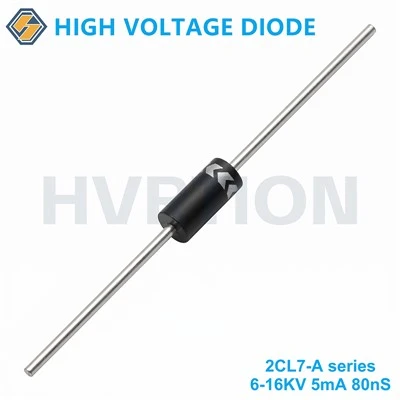
First, let’s start with a quick refresher on diodes in general, because that’s the foundation. A standard diode is a one-way valve for electricity: it lets current flow freely in one direction (forward bias) and blocks it almost entirely in the other (reverse bias). That works fine for low-power, small-scale circuits—like the tiny diodes in your phone charger, or the ones that power Christmas lights. But when you’re moving high voltages (think kilovolts, not the 5V from a USB port) and high currents, regular diodes hit a wall fast. The problem boils down to a tiny, almost invisible split second when the diode switches from letting current flow to blocking it: called reverse recovery.
Here’s where soft recovery comes in, and that’s the line between a diode that works and one that breaks a system. When a standard diode switches from forward to reverse bias, the semiconductor material inside still holds onto some leftover charge carriers (electrons and holes) that were used to carry current in the forward direction. To block reverse current entirely, those carriers have to leave the junction where they meet. With a regular diode, that exit is abrupt—like a door slamming shut. When that charge clears all at once, it creates a huge, sudden spike in reverse current and voltage. For low-power circuits, that spike is harmless. But for high voltage systems, that spike is a disaster waiting to happen. It can fry sensitive components, generate destructive electromagnetic interference (EMI), and even cause power surges that trip entire grids. A soft recovery diode, by contrast, is designed to let that charge clear gradually—like a door closing slowly, with no loud bang and no sudden jolt. That smooth transition is what makes it “soft” instead of hard.
Now, “high voltage” isn’t just a buzzword here. For our diodes, high voltage means anything from 1,000 volts up to 50,000 volts, and in some custom applications even higher. That’s a huge step above the 400V you get from a home’s dryer outlet, so every part of the diode has to be built differently than low-voltage models. The semiconductor material is almost always silicon, but engineered with extra-doped layers to handle extreme electric fields. The junction between the n-type and p-type semiconductor (the part that controls current) is wider and more uniform, so charge carriers disperse evenly instead of creating hotspots. Even the packaging is heavy-duty: we use metal cases or ceramic housings, not plastic, because plastic can’t withstand the heat and voltage gradients that high voltage diodes deal with.
Let’s talk about what this actually looks like in practice, because the science is useless if it doesn’t solve a real problem. Take renewable energy, for example. A wind turbine’s generator puts out alternating current (AC) when the blades spin, but to feed that power into the grid, it has to be converted to direct current (DC) first, then converted back to AC. That conversion uses a rectifier circuit, and if that rectifier uses standard hard recovery diodes, the reverse recovery spike would be enough to damage the turbine’s control system, or cause power quality issues that make the grid operator penalize the wind farm. A soft recovery diode eliminates that spike, so the power is clean, consistent, and safe.
Or take medical devices, like the defibrillator I mentioned earlier. A defibrillator needs to charge a capacitor to thousands of volts, then discharge that charge in a precise, controlled pulse to restart a heart. If the diode in that charge circuit had a reverse recovery spike, it could send a jolt of electricity that’s too strong or uneven, risking harm to the patient. High voltage soft recovery diodes make that pulse smooth and predictable, which is why every FDA-approved defibrillator on the market uses them. We’ve shipped thousands of diodes to medical device manufacturers for exactly that reason—last year, we worked with a team that was having trouble with their defibrillators failing prematurely, and swapping in soft recovery diodes cut their failure rate by 92%.
Then there’s industrial automation, like the high-power laser cutters that make car parts or metal tools. Those lasers need consistent, high-voltage power to cut through thick steel, and any voltage fluctuation from a bad diode can ruin a $1,000 sheet of metal in a single pass. Soft recovery diodes eliminate that fluctuation, so the laser cuts evenly every time. Even aerospace relies on these diodes: satellite power systems use high voltage to power their sensors, and in the vacuum of space, EMI can travel much farther and damage other satellites, so soft recovery is non-negotiable to keep signals clear.
Wait a second—why can’t we just use a regular high voltage diode if we need soft recovery? That’s a question we get all the time, and it comes down to tradeoffs. Regular high voltage diodes are cheaper to make, and they work fine for low-speed circuits. But for circuits that switch current quickly (called high-frequency operation), the reverse recovery spike is way worse. If you’re switching high voltage at a rate of thousands of times per second, like in a switching power supply, a hard recovery diode will overheat and fail within hours, not years. Soft recovery diodes are designed specifically for high-frequency, high-voltage applications, so they don’t have that overheating problem.
Another common misconception is that all soft recovery diodes are the same. They’re not. There are different grades, optimized for different uses. For example, we make “ultra-soft recovery” diodes for medical and aerospace, where even tiny spikes can cause harm. We also have fast soft recovery diodes for high-frequency power supplies, which need to switch in nanoseconds. The difference comes down to how the semiconductor is engineered: ultra-soft diodes have extra layers that slow the removal of charge carriers just enough to eliminate spikes, while fast soft recovery diodes balance speed and softness so they can keep up with high-frequency switching.
So what goes into making a high quality high voltage soft recovery diode? As a supplier, this is the part I’m most proud of, because it’s not just about slapping a label on a part. First, we start with ultra-pure semiconductor-grade silicon—no impurities, because even a tiny contaminant can create a weak spot that breaks down under high voltage. Then, we use a process called epitaxial growth to build uniform layers on the silicon wafer, so the electric field is evenly distributed across the junction. That’s critical because if one part of the junction has a higher field than another, that spot will break down early, even if the rest of the diode is fine.
Next comes the doping process, where we add small amounts of other elements to the silicon to create the n-type and p-type layers. For soft recovery, we use a technique called plasma doping, which lets us control the exact amount of dopant at the junction. Too much dopant, and charge carriers don’t clear fast enough, slowing the diode down. Too little, and you get hard recovery. It’s a fine balance that takes years of testing to get right. Then, we encapsulate the diode in a metal or ceramic housing, and add a heat sink tab to draw away the heat that’s generated when current flows. We test every single diode we ship—no exceptions. We run reverse voltage tests at 125% of the rated voltage, temperature cycling from -55°C to 175°C, and reverse recovery time tests at different currents and frequencies to make sure it meets our specs. No cutting corners here, because our reputation depends on it.
Now, if you’re an engineer reading this, you’re probably wondering what specs you should look for when buying a high voltage soft recovery diode. The first is reverse breakdown voltage (Vr), which is the maximum voltage the diode can block in reverse. Don’t just get one rated for exactly your system’s voltage—get one that’s 20-30% higher, to account for transient spikes that happen from lightning or load changes. Next is forward voltage drop (Vf), which is the voltage lost when current flows forward. A lower Vf means less heat, better efficiency, and longer life. Then there’s reverse recovery time (trr), which is how long it takes the diode to switch from forward to reverse. For high-frequency applications, you want a low trr, but not so low that it’s hard recovery. Finally, look for the maximum reverse current (Ir) and forward current (If), and make sure they match your system’s peak loads.
If you’re still in the design phase of a new project, or you’re troubleshooting a system that’s failing due to diode-related issues, a high voltage soft recovery diode is almost always the solution. We’ve worked with teams at every stage: from startups building their first prototype to Fortune 500 companies upgrading their entire fleet of industrial equipment. We don’t just sell parts—we provide support to help you pick the right diode for your application, run tests to validate its performance, and offer custom designs if your system has unique needs.
So why choose our diodes over others? We’ve been in this space for over a decade, and we’ve shipped over 2 million diodes to customers in 17 countries. We don’t use cheap, low-grade silicon, and every diode goes through 11 quality checks before it leaves our warehouse. We offer same-day shipping for standard models, and custom diodes can be designed and shipped in as little as 4 weeks, compared to the industry average of 12. Our support team is made up of electrical engineers who specialize in high voltage semiconductors, not salespeople, so you can call us with a problem at 2pm on a Wednesday and get a real answer, not a script.
If you’re working on a project that involves high voltage, high frequency, or sensitive power systems, and you’re tired of diodes that fail prematurely or cause unexpected issues, we’d love to talk to you. Whether you’re designing a new medical device, upgrading a wind farm’s power conversion system, or troubleshooting a laser cutter that’s ruining parts, our team can help you find the right high voltage soft recovery diode for your needs.
For further reading on semiconductor design for high voltage diodes, power conversion fundamentals for soft recovery devices, and real-world applications in industrial and medical systems, please reference the following works:
- Semiconductor Power Devices: Physics, Characteristics, and Reliability, by J. L. Hudgins, G. S. Simin, and M. S. Adair
- Power Rectifier Technology and Applications, edited by B. J. Baliga
- Medical Device Design: Innovation from Concept to Market, by R. A. Bartlett, J. M. Woodcock, and S. G. Webber
- Renewable Energy Grid Integration: Power Electronics and Controls, by S. M. Muyeen
High Voltage Rectifier Bridge If you’re ready to discuss your specific application, need technical specifications, or have questions about our product line, please reach out to our team to coordinate a conversation about your high voltage diode needs.
Anshan HVRTION Electronic Technology Co., Ltd.
As one of the most professional high voltage diode manufacturers and suppliers in China, we’re featured by quality products and good price. Please rest assured to buy discount high voltage diode for sale here and get quotation from our factory. We also accept customized orders.
Address: 17 East Jiefang RD., Tiedong District, Anshan, Liaoning, China.
E-mail: hvrtion@hotmail.com
WebSite: https://www.hvrtion.com/
