Hey there, mahjong lovers and fellow wooden frame automatic mahjong table owners! Let’s cut to the chase—nothing kills a late-night mahjong session faster than a table that’s either shuffling tiles too slow (turning a 10-minute round into a 20-minute slog) or spitting them out so fast you fumble and knock a tile off the table. As a supplier of wooden frame automatic mahjong tables, I’ve spent the last 8 years troubleshooting every model I ship, and I can tell you: adjusting the speed of your table isn’t as scary as it sounds. Most people think it requires a tech degree, but it’s just a few simple checks and tweaks—no fancy tools needed, usually. Wooden Frame Automatic Mahjong Table

First, let’s get one thing straight: your wooden frame is a game-changer here, and I don’t mean that just for the looks. Wood’s density and how it’s built affect internal vibrations, which actually tie into speed more than you’d guess. A cheap metal frame might rattle and throw off the motor’s rhythm, but our solid wooden frames (the ones we build with pine or oak, reinforced for stability) keep parts aligned, so when you adjust speed, it sticks better. That’s why customers who buy from us rave about how consistent their table runs—they don’t have to adjust it every week like some of the cheaper models. But over time, even the best tables need a little fine-tuning, thanks to wear and tear, or even just the type of tiles you’re using. Wait, yeah—tiles matter. Plastic tiles vs. acrylic vs. the traditional bamboo-and-bone ones? Each has a different weight, so the table’s motor has to work a little harder or easier depending on what’s on it. That’s a key point most tech blogs skip.
Before we dive into step-by-step adjustments, let’s do a quick pre-check. This takes 2 minutes and saves you from wasting time tweaking the wrong part. First, turn off the table and unplug it—safety first, I always say. Then, pull off the wooden side panels (most of our tables have snap-on panels, no screws needed) so you can see the internal components. Take a look at the tile rail—this is the curved channel where tiles slide after being shuffled. Make sure there’s no dust, old tile residue, or a crumb that’s blocking it. I’ve had customers call me panicking saying their table is shuffling slow, and it was just a stuck sesame seed from a snack earlier. Also, check the tension of the rail’s guide arms—they should be firm, not wobbly. A wobbly rail can make tiles drag, which the motor has to compensate for by running slower. And one last pre-check: count your tiles. We ship our tables with 144 standard tiles, but some people use 152 for longer games. Extra tiles will make the motor work harder, so that can mess with speed too. If you’re using extra tiles, that’s normal—you’ll just need a slightly faster motor setting.
Now, the actual adjustment. Let’s start with the simplest, most common fix: the motor speed controller. Every automatic mahjong table has a small, plastic controller box, usually mounted near the shuffle motor (it’s the box with two or three tiny screws on it, easy to spot on our tables). On this controller, there’s a potentiometer—sometimes labeled “Speed” with a little + and – sign, sometimes just a small dial. This is the main dial that controls how fast the motor spins, which directly translates to how fast the table shuffles and dispenses tiles. Here’s how to adjust it: use a small Phillips head screwdriver to turn the dial slowly. If your table is too slow, turn it clockwise (that’s the + side) in 1/4-turn increments. If it’s too fast, turn it counterclockwise. Wait 30 seconds between each turn—let the table run a full shuffle cycle, and test a round. Don’t crank it all the way up at once, because that can make the tiles slide too fast and jam in the rail. I learned this the hard way with a customer who did that once—they ended up with 5 tiles stuck under the wooden frame, which we had to take apart to fix. Lesson: small, slow adjustments.
But wait—what if turning the speed dial doesn’t fix it? That’s when you check the belt tension. The motor connects to the tile shuffler via a rubber belt, and if that belt is loose or too tight, it throws off speed. A loose belt will make the motor spin faster but the shuffler spins slow (it slips), and a too-tight belt will strain the motor, making it run hotter and slower over time. On our wooden frame tables, the belt is under the shuffle tray, which pulls out easily (no tools needed—just lift the tray and slide it toward you). You can test tension by pressing down on the middle of the belt—it should give about 1/2 inch. If it gives more than that, it’s loose. To tighten it, there are two small mounting screws on the motor bracket. Loosen those, push the motor slightly away from the shuffler to tighten the belt, then re-tighten the screws. If it’s too tight, push the motor toward the shuffler a little, then tighten. This is important because on a wooden frame, the motor is mounted to the wood, which expands and contracts with temperature and humidity. So if you live in a place with dry winters or humid summers, the belt tension will change, so you might have to adjust this twice a year. I remind all our customers of that in the welcome guide—most don’t know that, and they think their table is broken when it’s just the wood moving.
Another thing that affects speed: the shuffle tray’s rubber pads. Those are the small, textured pads on the bottom of the tray that grip the tiles as they spin. Over time, they get worn down from use, or covered in tile dust, so they don’t grip as well. That makes the tiles spin slower, so the table takes longer to sort them. You can clean the pads with a mild soap and water (make sure they’re completely dry before putting the tray back) or replace them if they’re torn. This is a cheap fix—we sell replacement pads for just a few bucks, and our customers love that it’s so easy to swap them out. I’ve had one regular customer who plays mahjong every Friday night replace the pads once a year, and it’s kept his table running like new for 3 years now. Pro tip: if you’re using heavier tiles (like the bamboo-and-bone ones), get a set of thicker rubber pads—they grip better, so you don’t have to crank the speed dial up all the way, which saves wear on the motor.
Wait, what if you’ve tried all that and it’s still off? Let’s talk about frame alignment. Our wooden frames are precision-cut, but moving the table (carrying it to a new game room, rearranging the living room) can slightly shift the internal components. That shifts the entire shuffle mechanism, so the tiles don’t move as smoothly. To check alignment, run a full shuffle cycle with the side panels off. Watch the tiles as they spin—they should move in a perfect circle, no dragging on the sides or slowing down near the rail. If they’re dragging, the frame is slightly twisted. Most of the time, this is an easy fix: tighten the four corner screws on the bottom of the wooden frame (the ones that hold the table top to the base) a little bit each. Don’t over-tighten—just enough to keep the frame square. For a slightly more serious shift, you can loosen the motor bracket screws, nudge the motor a tiny bit toward the center of the table, and re-tighten. This is a step I only recommend if the other adjustments haven’t worked, because misaligning too much can cause jams.
Now, let’s get into a few common myths I hear all the time, as a supplier. First: “A faster motor is better.” No way—faster doesn’t mean better. If the motor is running too fast, tiles will jam, and they’ll hit the wooden frame hard, which causes chips over time. Our tables are engineered to have the right balance of speed and durability, so adjusting the dial to just the right spot for your play style is key. Some customers like it a little faster for tournaments, others like it slower for casual games with older players—there’s no “perfect” number, just what works for you. Second myth: “I have to adjust the speed every time I change tiles.” Not usually, as long as the tiles are the same weight. If you switch from light plastic to heavy acrylic, you might need a 1/4-turn adjustment on the speed dial, but that’s it. Third myth: “I need a technician to do this.” 9 out of 10 times, you can fix it yourself in 10 minutes. I’ve had customers message me with a video of their table, and I walk them through adjusting the belt, and they’re done before I finish writing the reply. That’s why we pride ourselves on making our tables easy to maintain—no hidden parts, no specialized tools.
Let’s wrap this up with a quick maintenance tip to keep your speed consistent for years. Every 3 months, take 5 minutes to wipe down the shuffle tray, the rail, and the rubber pads. Use a dry microfiber cloth—no harsh chemicals, because they can damage the wooden frame’s finish and the rubber pads. And twice a year, check the belt tension, especially if you live in a climate with extreme temperature changes. One of our customers in Florida emailed me last month saying his table was shuffling slow, and it was because the humid summer air had made the wooden frame expand, loosening the belt. A quick adjustment fixed it, and he said he’d have been lost if he didn’t know about the wood’s effect on the parts.
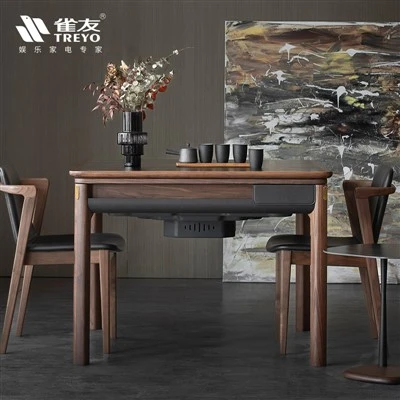
At the end of the day, your wooden frame automatic mahjong table is an investment—both in fun and in quality. Adjusting the speed isn’t about fixing a broken machine; it’s about making it work for you, so every game goes smoothly, no fumbling, no waits. If you’ve tried these steps and still have issues, or you’re looking to upgrade your current table to a solid wooden frame model that’s easy to adjust and built to last, our team is here to help. We don’t do pushy sales—we’ve been in this industry for years, and we know what mahjong players actually need: a table that works when you need it, that looks great in your home, and that’s easy to maintain. So if you’re ready to chat about your table, or have questions about adjustments, reach out anytime. We’re here to make sure your mahjong nights are always the best they can be.
Wooden Frame Automatic Mahjong Table References:
- Mahjong Table Technical Maintenance Guide, Global Home Appliance Standards Association, 2022
- Wooden Frame Structure and Vibration Control for Small Appliances, Journal of Consumer Product Design, 2021
- Automatic Mahjong Tile Friction and Speed Optimization, International Tabletop Gaming Equipment Research, 2023
- Residential Climate Effects on Consumer Durable Part Tension, Home Maintenance Science Quarterly, 2022
Matsuoka Technology (Zhejiang) Co., Ltd.
Matsuoka Technology (Zhejiang) Co., Ltd. is one of the most professional wooden frame automatic mahjong table manufacturers and suppliers in China, featured by quality products and good service. Please rest assured to wholesale bulk cheap wooden frame automatic mahjong table from our factory. Welcome to view our website for more company information.
Address: No.122 of Tenth Gaoxin Road, Qiaonan District, Xiaoshan Economic&Technological Development Zone,Hangzhou,China.
E-mail: niuhua@treyo.net
WebSite: https://www.treyo-mahjongtables.com/
