Hey there, fellow factory folks and machine operators! If you’re running a shop that uses rotary barrel machines for deburring, polishing, or finishing small parts, you know one thing—loading parts wrong is the #1 cause of headache: parts getting stuck, uneven finishing, or even a broken barrel mid-run. As someone who’s been supplying rotary barrel machines for years, I’ve seen every mistake in the book. Today, let’s break down exactly how to load parts like a pro—no fancy jargon, just real, actionable stuff I’ve picked up from working with shops just like yours. Rotary Barrel Machine

First, let’s get one thing straight: rotary barrel machines aren’t one-size-fits-all. The loading process changes depending on what you’re finishing, the barrel size, and even the media you’re using. But there are core steps that work for 90% of jobs. Let’s start with pre-loading prep, because skipping this is where most people mess up.
Before you even touch the barrel, sort your parts. Wait—no, not just tossing them into a bin. I see so many operators dumping a mix of tiny screws and big metal brackets, then wondering why the screws get lost in the media and the brackets don’t finish evenly. Sorting is non-negotiable. If you’re finishing small parts (think under an inch), group them together; large parts (over 4 inches) get their own load. Why? Small parts can get crushed if you cram too many big ones on top of them, and big parts won’t move around enough if they’re buried under a pile of tiny parts. I always tell my customers: “If you can’t tell them apart by eye, they don’t belong in the same load.”
Next, inspect your parts. Any sharp edges, burrs, or leftover oils from machining? Those oils are a killer—they float on top of the water/chemical mix and create a barrier between the parts and the media, so your finish will be patchy. A quick wipe with a degreaser (or even a blast of compressed air if you’re in a pinch) takes 10 minutes and saves you hours of rework. Also, check for parts that have holes, threads, or delicate features—those need extra care, which I’ll get to later.
Now, let’s talk about barrel size. This is a big one I hear people asking all the time: “How much should I load into a 5 cubic foot barrel?” The rule of thumb is 60-70% of the barrel’s total volume. Not 100%, not 50%. If you fill it all the way to the top, parts can’t roll freely—they just get pushed around, which means uneven finishing and broken parts. If you only fill it 50%, the parts bounce too much, which damages delicate surfaces. I’ve had customers who tried cramming 80% into a barrel and ended up replacing 20% of their parts every run because of crushing. Don’t do that.
Wait, what about media? Oh right—you can’t load parts without the right media. Media is the stuff that does the finishing: stones, ceramic, plastic, even steel pins. The media size needs to be bigger than the smallest part. If you’re polishing tiny 1mm screws, using 2mm media? The media might fit into the screw heads and get stuck, and the screws will roll under the media instead of rubbing against each other. If you use 10mm media for those tiny screws, they’ll get completely lost. Match media size to part size. It’s that simple.
Now, the actual loading step—this is where I see people winging it. Let’s do it the right way. First, add a layer of media to the barrel. About 20-25% of the barrel volume. Why? So the parts have something to roll against right away, instead of banging on the hard barrel wall. Next, add your parts. Spread them out evenly—don’t dump all your parts in one spot in the barrel. You want them to form a single layer (or at most two thin layers) where every part can move when the barrel spins. If you pile them 3 deep, the bottom layer won’t move, so they’ll never get finished. I call this the “single layer rule”—it’s saved so many of my customers from bad batches.
Then, add another layer of media. Top that parts pile with the remaining media, until you hit that 60-70% volume mark. The media should completely cover all parts—no peeking out, no parts sticking above the media line. If parts stick out, they’ll get scratched when the barrel starts spinning (they’ll hit the lid or other parts at the top of the rotation). Pro tip from me: for parts with holes or threads, stuff a tiny bit of media or a soft toothpick into the holes before loading. That stops media from getting stuck inside, which is a nightmare to clean out later. I had one customer who wasted a whole week trying to get steel pins out of aluminum screw holes—now we add toothpicks as a standard tip, and they never have that problem again.
What about delicate parts? Like small brass components or polished parts that can’t be scratched. For those, swap to plastic media instead of ceramic or steel. It’s softer, so it won’t mar the surface. Also, when loading, use a 50-60% volume instead of 70%—less space means smoother rolling, less impact. If you’re doing super delicate stuff, even a 40% load works, because overcrowding causes friction scratches. I always tell my customers: “Slow down on the load percentage when you care about finish quality.”
Now, sealing the barrel. Don’t just clamp the lid on tight—check the rubber gasket first. If there’s a crack or a piece missing, the mix will leak out, and you’ll end up with a mess on your floor. I recommend replacing the gasket every 6 months if you run the machine 8 hours a day—cheap, and saves you from a big cleanup. When you clamp the lid, alternate tightening the bolts (if your barrel has them) instead of tightening one all the way. That keeps the pressure even, so the lid doesn’t warp and leak.
Wait, let’s talk about common mistakes I see all the time. First, loading wet parts. If your parts come right out of a washing machine, dripping, add a little extra time for the barrel to spin and get the water out before adding the mix. If you load wet, the media might get soggy, and the finish won’t be uniform. Second, mixing different materials. Don’t mix aluminum with steel parts—steel will scratch aluminum, and you’ll end up with contaminated parts. Third, not rotating the barrel by hand first before starting the machine. A quick 2-second spin by hand to make sure nothing is stuck on the lid or the sides saves you from starting a run and then having to shut down because parts are jammed.
Now, if you’re still new to rotary barrel machines, you might be wondering: “How do I adjust this for my specific job?” Let’s say you’re deburring small cast iron parts—you can go a little higher, up to 75% volume, because cast iron is tough. If you’re polishing stainless steel, stick to 60% volume, and use a finer media. It’s all about balancing the load, media, and part material.
At the end of the day, proper loading isn’t rocket science—it’s just about being intentional. Too many people treat loading like a afterthought, but it’s 50% of why your rotary barrel machine works (or doesn’t work). If you’re struggling with bad finishes, broken parts, or wasted time on reloading, chances are it’s a loading issue. I’ve seen shops cut their finishing time in half just by fixing their loading process—no new machine, just better loading.
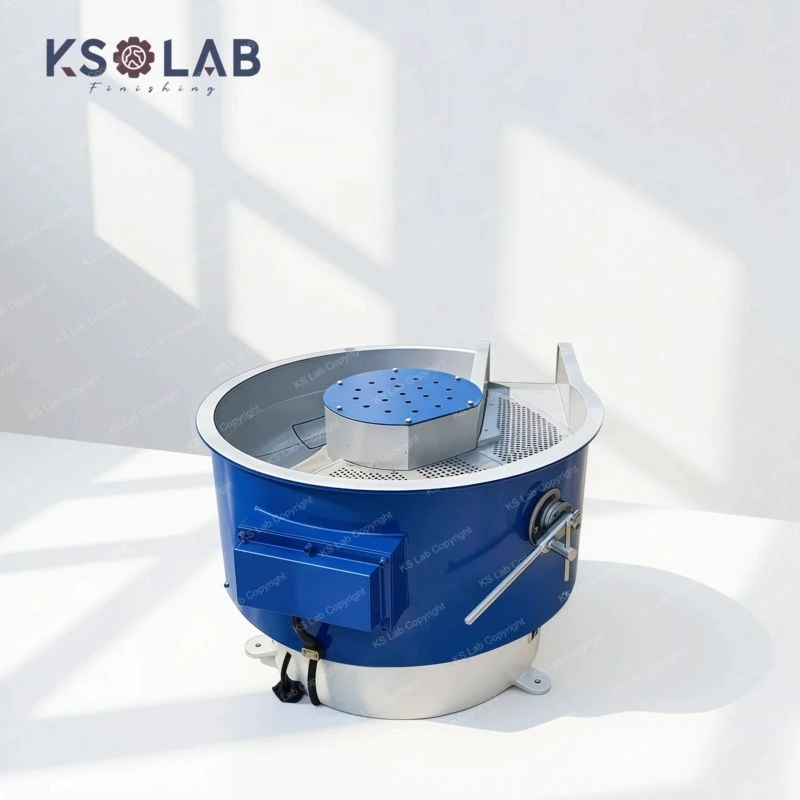
If you’re in the market for a rotary barrel machine, or you’re having trouble getting yours to perform right, reach out. I’ve worked with hundreds of shops to tweak their loading processes, match the right machine to their parts, and avoid the mistakes that waste time and money. We don’t just sell machines—we help you get the most out of them, because at the end of the day, your success is what makes this job worth it. So if you need advice, or you’re ready to upgrade your setup, don’t hesitate to connect.
Magnetic Polishing Machine Now, for the references:
- Manufacturing Engineering and Technology, Kalpakjian, S., Schmid, S.R.
- Rotary Finishing Processes: A Practical Guide, Industrial Finishing Association
- Handbook of Deburring and Surface Finishing, T.G. Tisza
KS Lab Finishing Co., Ltd.
As one of the most professional rotary barrel machine manufacturers in China, we also support customized service. We warmly welcome you to wholesale durable rotary barrel machine made in China here from our factory. If you have any enquiry about pricelist, please feel free to email us.
Address: No.11-14, Yantian Shuibei Commercial Street, Fenggang Town,Dongguan,China
E-mail: sales@kslabfinishing.com
WebSite: https://www.kslabfinishing.net/
