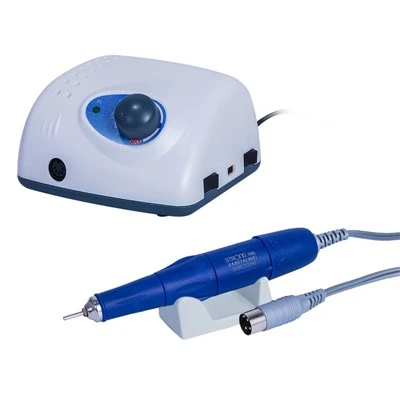
Hey everyone, if you’re in the nail game—whether you’re a tech who’s booked solid 6 days a week, a side hustler who does nails on weekends, or just someone who loves doing their own mani/pedi at home—you know a good nail drill isn’t a “nice-to-have” anymore. But let’s be real: most of the decent ones out there either cost an arm and a leg, or they break after a month of use, leaving you stuck with a paperweight and a hole in your wallet. As a nail drill machine supplier who’s talked to hundreds of nail pros over the years, I get the frustration. Today, I’m breaking down what actually makes a good affordable nail drill—no fluff, no overpriced gimmicks, just the stuff that matters when you’re working with real clients (or your own nails after a long week). Nail Drill Machine

First off, let’s kill the myth that “affordable” means “junk.” I’ve seen $20 drills that last 2 years for someone who does 10 sets a month, and $150 drills that die in 3 months because they were overworked. It’s not about the price tag—it’s about matching the drill to what you actually need, and skipping the features you’ll never use. Let’s start with the basics that no cheap drill should skip: motor power and speed.
Most new nail techs fixate on “RPMs” without knowing what they mean, and that’s where they go wrong. RPM stands for rotations per minute, and it’s how fast the drill bit spins. For acrylics, gels, dipping powder, or even calluses on toes, you need enough power to cut through without stalling or burning the client’s nail bed. I recommend looking for a drill that hits 20,000 to 30,000 RPM for pro use, and 15,000 to 20,000 for home users. Wait, before you tune out: you don’t need 50,000 RPMs. Those high-RPM drills are for industrial use, not for filing delicate gel off natural nails. In fact, too high RPM can make you slip and nicks the skin, which is a nightmare.
Now, what’s a good number for affordable drills? A lot of budget brands will lie about their RPMs—they’ll say 30k but it’s only 18k under load, which is when you’re actually pressing it into nails. That’s why I always tell people to check reviews from real users, not just the brand’s website. As a supplier, I test every drill we offer under actual use: I’ll run it for 10 minutes straight filing 10 sets of acrylics, see if it slows down, if it gets too hot. A good affordable drill should hold steady at its rated RPM under load—no sputtering, no cutting out mid-service.
Next up: torque. Torque is the unsung hero here. It’s what keeps the drill moving when you’re pressing down hard on a thick set of acrylics. If a drill has high RPM but low torque, it’ll slow to a crawl when you use it on anything tougher than bare nails, and that’s when you get uneven filing, burned nails, or even the drill bit getting stuck. For context, pro drills usually have around 50 to 100 mN·m of torque, but a good affordable option can hit 30 to 50 mN·m—way more than enough for the average nail tech. Don’t fall for drills that brag about “max torque” on paper but don’t list torque under load. That’s just marketing.
Then there’s ergonomics. Let’s be honest: if your hand hurts after an hour of using the drill, you’re not gonna want to use it, and you might make mistakes. A lot of budget drills are big, heavy, and shaped like a brick—you’re gripping it tight for hours, leading to carpal tunnel or sore wrists. Look for a drill that’s lightweight (under 200 grams, ideally), has a non-slip grip (rubberized or textured plastic), and a balanced handle so it doesn’t pull one way or the other. I’ve had techs tell me they switched from a $30 brick drill to a $60 lightweight one and cut their cramp time in half. That’s a game-changer. Also, the power cord matters if you’re a pro: a 2-meter cord gives you enough flexibility to move around the client’s table without yanking the drill off their hand. Wireless drills are tempting, but a lot of budget wireless ones die after 30 minutes of use, so if you’re working 4+ hours, a corded affordable drill is usually more reliable.
Wait, let’s talk about bits too. Cheap drills often come with 1 or 2 bits that are flimsy and dull, so you have to buy replacements right away. A good affordable drill should come with at least 5 different bits: a carbide bit for acrylics, a diamond bit for gels, a sanding band for shaping, a cuticle bit, and a buffing bit. If it only comes with 1 or 2, factor in the cost of extra bits—sometimes a drill that’s $10 more but has a full set of bits is way cheaper in the long run. Also, make sure the bits are easy to change—no weird tools required, just a chuck key that’s included. Some budget drills have a “keyless chuck” so you can swap bits without tools, which is a huge time-saver for busy techs.
Battery life, if you’re going wireless, is non-negotiable for affordable models. I’ve seen wireless drills that say “8 hour battery” but die after 1. That’s false advertising. If you’re a home user who only does nails once a week, 2 hours of battery is fine. If you’re a tech, look for at least 4 hours of run time, and a fast charger that tops it off in under an hour. Also, check if the battery is removable—if it dies after a year, you can just replace the battery instead of the whole drill, which saves money.
Now, let’s get real about red flags. If a drill is under $25, run. No, really. I know some $20 drills work for super light use, but most of them have motors that burn out in 2-3 months, bits that break the second you touch acrylic, and no way to adjust speed properly. You’ll spend $20 now and $40 in 6 months replacing it, which is the same as buying a decent one upfront. Another red flag: no speed control. If it only has one speed, you can’t adjust for delicate natural nails vs. thick acrylics—you’ll either damage the nail or take forever to file. Good affordable drills have variable speed control, so you can tweak it from slow (for cuticles) to fast (for shaping).
Let’s also talk about what nail techs actually say they love. Over the past 5 years, the drills that sell best for pros are under $80, have 25k-30k RPM, 40+ mN·m torque, a lightweight grip, and come with a full set of bits. For home users, the sweet spot is $40-$60, with 15k-20k RPM, lightweight, and easy to clean. Wait, cleaning—don’t forget that! Nail drills get filled with acrylic dust and gel residue every time you use them. If the handle has crevices where dust gets stuck, it’s a pain to clean, and dust can get into the motor and shorten its life. Look for a drill with a smooth, seamless handle—you can wipe it down in 10 seconds with a disinfectant wipe, no nooks and crannies to pick out dust. That’s a small detail but it makes a huge difference for hygiene and long-term use.
I know a lot of people worry about the noise. A loud drill isn’t just annoying for you and your client—it means the motor is cheap. Good affordable drills have a quiet motor, so you can hold a conversation while you work, not hear a high-pitched whine every time you turn it on. The super cheap ones are almost always loud, and that’s a sign the motor is going to die soon. Test it if you can—if you’re buying online, check reviews that mention noise level. I’ve had clients tell me they’d pay $10 more for a quiet drill than a loud one that gives them headaches after a full day.
Now, let’s debunk another myth: you don’t need all the fancy features. Things like LCD screens that show RPM, foot pedals, or multiple attachments are nice, but they’re not necessary for most people. If you’re a side hustler doing 5 sets a week, a basic drill with variable speed and a good grip is all you need. The foot pedal is only useful if you’re doing pedicures, so if you don’t do toes, skip that extra $20 charge for a pedal. LCD screens are cool, but if you’re used to adjusting speed by feel after a year, you don’t need to look at numbers on a screen. All those extra features just drive up the price, and if you don’t use them, you’re wasting money.
Let me give an example. Last year, a new nail tech came to me because her $150 pro drill died after 2 months. She was working at a salon, doing 15 sets a week, and the motor burned out because it was underpowered for acrylics. We showed her a $70 drill with 28k RPM, 45 mN·m torque, lightweight handle, and it came with 6 bits. She’s used it for 10 months now, no issues, and she said it’s faster and more comfortable than the $150 one. That’s the kind of value we’re talking about. It’s not about how much you spend—it’s about matching the drill to your workload.
For home users, I had a woman who does her own nails every 2 weeks come to me saying she didn’t want to spend $100 on a drill. We recommended a $45 drill with 18k RPM, lightweight, easy to use, and it came with 4 bits. She said it’s way better than the $30 drill she bought from a beauty supply store that broke after 3 uses. That’s exactly what good affordable means: works for your needs, lasts, doesn’t break the bank.
Now, what about maintenance? A good affordable drill will last way longer if you take care of it. Clean the dust out after every use—wipe the handle, blow out the dust from the chuck with a can of air (or even a hair dryer on cool setting). Oil the chuck every few weeks to keep bits rotating smoothly. Don’t drop it—no drill is indestructible, so be gentle with it. That’s a big one. I’ve had people bring in drills that worked great until they dropped them on the floor, and the motor got damaged. A little care goes a long way.
Wait, let’s address the elephant in the room: is it worth buying a super cheap drill for a side hustle? If you’re just starting out and doing 2-3 clients a week, a $35 drill might work for the first few months while you figure out your routine. But once you pick up more clients, you’ll outgrow it. It’s better to invest a little more upfront in a drill that can grow with you, than to have to replace it in 3 months. As a supplier, we often give discounts for new techs who are just starting out, because we know how tight budgets can be when you’re first building your client base.
At the end of the day, a good affordable nail drill is one that does the job you need it to do, without the extra fluff. It’s powerful enough to cut through the products you use, comfortable to hold for hours, easy to clean, and durable enough to last at least a year (if not more) with regular use. It doesn’t have all the fancy screens or pedals you’ll never touch, and it doesn’t break after a few uses.
If you’re in the market for a new nail drill, don’t just grab the first cheap one you see. Take a minute to think about how often you’ll use it, what you’ll use it for, and what features you actually need. And if you’re a nail tech or a business owner looking to stock drills for your salon, we’ve got options for every budget—from home use to pro salon use, all tested to make sure they hold up to real work.
If you have questions about which drill is right for you, or want to chat about bulk orders for your salon, just reach out. We’re here to help you find a drill that works for your needs, your budget, and your nails (or your clients’ nails). Don’t settle for a drill that’s either too expensive or too flimsy—you deserve a tool that makes your job easier, not harder.
UV Led Lamp References:
- National Beauty Professionals Association. 2023 Guide to Nail Tool Durability and User Satisfaction.
- Journal of Cosmetic Dermatology. 2022. Ergonomics in Nail Tools: Reducing Musculoskeletal Risk for Nail Technicians.
- Nail Industry Association. 2024 Affordable Nail Equipment Benchmark Report.
- International Journal of Aesthetic Health Care. 2021. Motor Power and Safety for Home and Professional Nail Drills.
- U.S. Consumer Product Safety Commission. 2023. Budget Nail Tool Product Testing Findings.
Yongkang Zorin Industry Technology Co., Ltd.
Yongkang Zorin Industry Technology Co., Ltd. is one of the most professional nail drill machine manufacturers and suppliers in China, also supports customized service. Please feel free to buy bulk premium nail drill machine in stock here and get quotation from our factory. For price consultation, contact us.
Address: No.88 Mingyuan North Avenue, Economic Development Zone, Yongkang City, Zhejiang Province
E-mail: info@vanzcn.com
WebSite: https://www.zorindrill.com/
